Click on any of the main images for a closer view

Friday, 14 June 2019

Snowy Owl on Great Blasket

This, the first record of Snowy Owl for Co. Kerry, was seen and photographed by Tom Nisbet near the highest point of the island, on 9th June. Unfortunately it hasn't been seen since though there is plenty of room on the island group, and plenty of prey. Snowy Owls can feed on a wide variety of birds and mammals, so the local rabbits and gulls should be very afraid.

Photo 1. Snowy Owl, Great Blasket, 9th June 2019 (Tom Nisbet).

Photo 1. Snowy Owl, Great Blasket, 9th June 2019 (Tom Nisbet).

The same photo again, but cropped in tighter.

Photo 2. Snowy Owl, Great Blasket, 9th June 2019 (Tom Nisbet).

Photo 2. Snowy Owl, Great Blasket, 9th June 2019 (Tom Nisbet).

The same photo again, but cropped in tighter.

Photo 2. Snowy Owl, Great Blasket, 9th June 2019 (Tom Nisbet).

The same photo, again tightly cropped, but there's a lot more information in this one. Here we can see dense black barring especially on the wings and mantle. So a young male, or maybe an adult female? However, ageing and sexing Snowy Owls is pretty tricky unless there is a lot of detail from good close-up photos of wings and tail. See for example this web page, Project Snowstorm HERE : 

That website explains; "Ageing Snowy Owls. The only accurate way to differentiate young snowies from adults is by looking for what banders [ringers] call “molt limits,” contrasts between older, more faded flight feathers, and newer, more blackly marked feathers. This can be subtle, and often requires a trained eye. The degree of barring and marking may decrease with age, as most birders assume, but may also remain the same or even darken — there is a great deal of variability."

and...

"Sexing Snowy Owls: Most birders assume that male snowies are whiter than females, and that is generally true. But the overlap in markings between the sexes is great and confusing. In first-year owls, females have more bars than spots on the middle secondaries, where males have more spots than bars. Female snowies generally have three or more bars on the tail, while males generally have three or fewer, although this is not diagnostic. The terminal dark tail band generally extends from edge to edge on females, but stops short of the edge of the feather in males."

So we can't say for sure what age or sex it might be, but most likely a female or young male.

Doesn't really matter though, does it? It's a Snowy Owl, and that should certainly be enough for anyone lucky enough to encounter such a magnificent bird.

Saturday, 8 June 2019

One good tern deserves another

The Gull-billed Tern is still present as of today, though the White-winged Black Tern at the same spot is now a fading memory. Here's a bit of video to keep it fresh in the mind.

White-winged Black Tern, Baile an Reannaigh, 3rd June 2019 (First clip, Michael O'Clery, second clip, David O'Connor). Click the '4-arrows' symbol for fullscreen.

Gull-billed Tern, Baile an Reannaigh, 7th June 2019 (Kilian Kelly).

Gull-billed Tern, Baile an Reannaigh, 7th June 2019 (Kilian Kelly).

Gull-billed Tern, Baile an Reannaigh, 7th June 2019 (Kilian Kelly).

Gull-billed Tern, Baile an Reannaigh, 7th June 2019 (Kilian Kelly).

Friday, 7 June 2019

More of the Gull-billed Tern

Gull-billed Tern, Baile an Reannaigh, 4th June 2019 (Seamus Enright).

Gull-billed Tern, Baile an Reannaigh, 4th June 2019 (Michael O'Clery).

Gull-billed Tern, Baile an Reannaigh, 4th June 2019 (Michael O'Clery).

Gull-billed Tern, Baile an Reannaigh, 4th June 2019 (Michael O'Clery).

Tuesday, 4 June 2019

Gull-billed Tern at Smerwick Harbour

Second-summer Gull-billed Tern, Baile an Reannaigh, 4th June 2019 (Michael O'Clery).

When Jill Crosher saw an unusual tern on the beach at Baile an Reannaigh last Sunday, thoughts of what it might have been were eclipsed by the presence of a pristine summer-plumaged White-winged Black Tern on the marsh nearby (see post below). Despite that, she saw the mystery tern again a couple of times until, this morning with Ed Carty, and while discussing the mystery bird on the beach, it flew directly overhead and inland - a Gull-billed Tern.


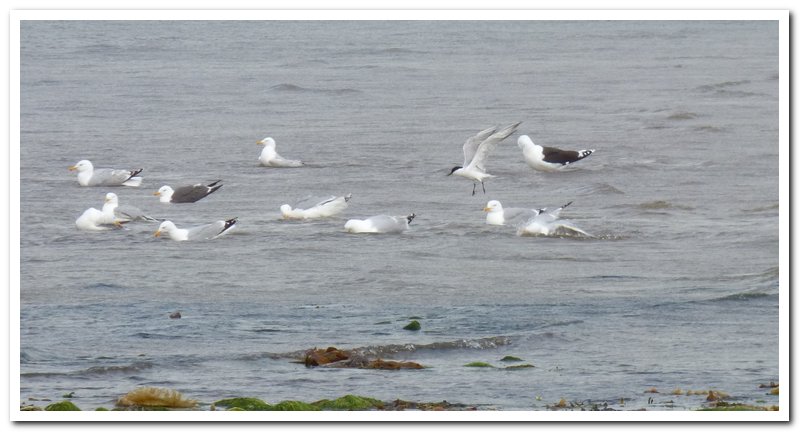
Gull-billed Tern (with Lesser Black-backed Gulls), Baile an Reannaigh, 4th June 2019 (Michael O'Clery).

The Gull-billed Tern was very elusive today, rarely lingering for long at any spot and ranging the full length and breadth of Smerwick Harbour and sometimes inland. These photos were taken while it flew into the marsh at Baile an Reannaigh for just ten minutes before flying out into the bay again. Persistence and a bit of luck seem to be a requirement of getting a good (or any) view.

Gull-billed Tern, Baile an Reannaigh, 4th June 2019 (Michael O'Clery).

Gull-billed Tern, Baile an Reannaigh, 4th June 2019 (Michael O'Clery).

Gull-billed Tern, Baile an Reannaigh, 4th June 2019 (Michael O'Clery).

On any half decent view, the Gull-billed Tern looks like an adult, with an obvious complete dark cap. Despite that, this photo (above) is most telling... The wedge-shaped dark area on the outer wing with an obvious 'moult-step', and a faint greyish bar on the secondaries makes this most likely a second-summer bird, i.e., hatched in 2017.

Gull-billed Tern, Baile an Reannaigh, 4th June 2019 (Michael O'Clery).

This is the 23rd record for Ireland, so considerably rarer than the White-winged Black Tern also seen today at the same spot, and also present since Sunday last.

The only other Kerry record was the long-staying bird first seen on 17th October 2015 at Blennerville which remained until the following December (see e.g., this page HERE).

Sunday, 2 June 2019

White-winged Black Tern at Baile an Reannaigh

White-winged Black Tern, Baile an Reannaigh, 2nd June 2019 (Michael O'Clery).

Found by Jill Crosher this evening this is the 12th record for Co. Kerry, but the first since an adult was seen at Blennerville in May 1983. An awful long wait considering the relative regularity of this species elsewhere in Ireland with 105 records up to the end of 2017. Long-overdue, but well worth the wait.

White-winged Black Tern, Baile an Reannaigh, 2nd June 2019 (Michael O'Clery).

White-winged Black Tern, Baile an Reannaigh, 2nd June 2019 (Michael O'Clery).


White-winged Black Tern, Baile an Reannaigh, 2nd June 2019 (Michael O'Clery).

Semipalmated Sandpiper at Ballinskelligs

Semipalmated Sandpiper, Ballinskelligs, 1st June 2019 (Pat McDaid).

The 63rd record for Kerry.

Semipalmated Sandpiper, Ballinskelligs, 1st June 2019 (Pat McDaid).

Semipalmated Sandpiper, Ballinskelligs, 1st June 2019 (Pat McDaid).

Semipalmated Sandpiper, Ballinskelligs, 1st June 2019 (Pat McDaid).

Semipalmated Sandpiper, Ballinskelligs, 1st June 2019 (Pat McDaid).

Monday, 20 May 2019

A third Intermedius Lesser Black-backed Gull

The darker-backed Intermedius Lesser Black-backed Gull (front) with one of our own graellsii Lesser-black-backed Gulls for easy comparison, Baile an Reannaigh, 18th May 2019 (Michael O'Clery).

If you don't like gulls, best to look away now. Intermedius Lesser Black-backed Gulls nest in coastal Scandinavia, Germany and Denmark, and other adjacent areas, and merge with our own slightly paler-backed graellsii race to the west, and the even darker 'Baltic Gull' further north and east. Baltic Gull is a true rarity in Ireland, Intermedius less so, and it is probably a regular spring and autumn passage migrant in small numbers every year. There have been three so far in Kerry this spring, and probably more to be found for those willing to look.

While the darker mantle and wings make it stand out from our local birds, there are structural differences too, such as the wingtips, or outer wings, look noticeably slender and long-looking by comparison.

Intermedius Lesser Black-backed Gull with Herring Gull (lower), Baile an Reannaigh, 18th May 2019 (Michael O'Clery).

Intermedius Lesser Black-backed Gull, Baile an Reannaigh, 18th May 2019 (Michael O'Clery).

Okay, enough now... I'm bored.

Sunday, 19 May 2019

Turtle Dove at Ventry

Turtle Dove, Ventry, 17th May 2019 (Britta Wilkens).

Turtle Dove, Ventry, 17th May 2019 (Britta Wilkens).

Turtle Dove, Ventry, 17th May 2019 (Britta Wilkens).

Tuesday, 7 May 2019

More spring birds

Turtle Dove, Dunquin, 29th May 2019 (Kilian Kelly).

White Wagtail, Blackrock, 11th May 2019 (David O'Connor).

Puffin, off Inishtearaght, Blasket Islands, 6th May 2019 (Michael O'Clery).

Wednesday, 1 May 2019

Selection of spring rarities 'out west'

Great White Egret, Baile an Reannaigh, 1st May 2019 (Cate O 'Donnell).

The ninth record for Kerry, and about the 125th for Ireland. This species is turning up with increasing frequency and it is possible that it might become a breeding species in Ireland in the coming years.

Great White Egret, Baile an Reannaigh, 1st May 2019 (Kilian Kelly).

Turtle Dove, Dunquin, 1st May 2019 (Cate O 'Donnell).

Marsh Harrier, Baile an Reannaigh, 1st May 2019 (Kilian Kelly).

The 28th record for the county.

Marsh Harrier, Baile an Reannaigh, 1st May 2019 (Kilian Kelly).

Marsh Harrier, Baile an Reannaigh, 1st May 2019 (Kilian Kelly).